Frequently Asked Questions
Advanced nuclear energy is a general term for newer reactor designs that improve on traditional nuclear power by focusing on safety, efficiency, and flexibility. These systems deliver reliable, carbon-free electricity while using less space and allowing for more adaptable construction and placement. Unlike most current reactors, which were custom-built facilities, newer advanced reactors are built using standard designs and can be tailored to different energy demands.
-
Advanced large reactors are a type of advanced nuclear energy that can generate more than 1,000 megawatts (MW). Advanced large reactors include built-in, or passive, safety features. These safety systems use gravity and natural circulation of cooling water, rather than pumps or backup power, to automatically shut down and cool the reactor, without operator action required.
-
SMRs are advanced nuclear reactors that typically generate between 50 and 500 megawatts (MW) and use water or other coolants such as helium. Advanced SMRs like those being evaluated in Sullivan County are designed with an intrinsic safety case, utilizing passive physics to ensure safety instead of mechanical backup systems.
Because the units are smaller, several are typically built at one site and added over time. A plant made up of multiple SMR units can have a total capacity well above 500 MW. The potential Sullivan County project, for example, would use 12 Xe-100 units of about 80 MW each, for a combined capacity of 960 MW. Each unit can come online as soon as it is complete, so capacity can be added to the grid one reactor at a time.
-
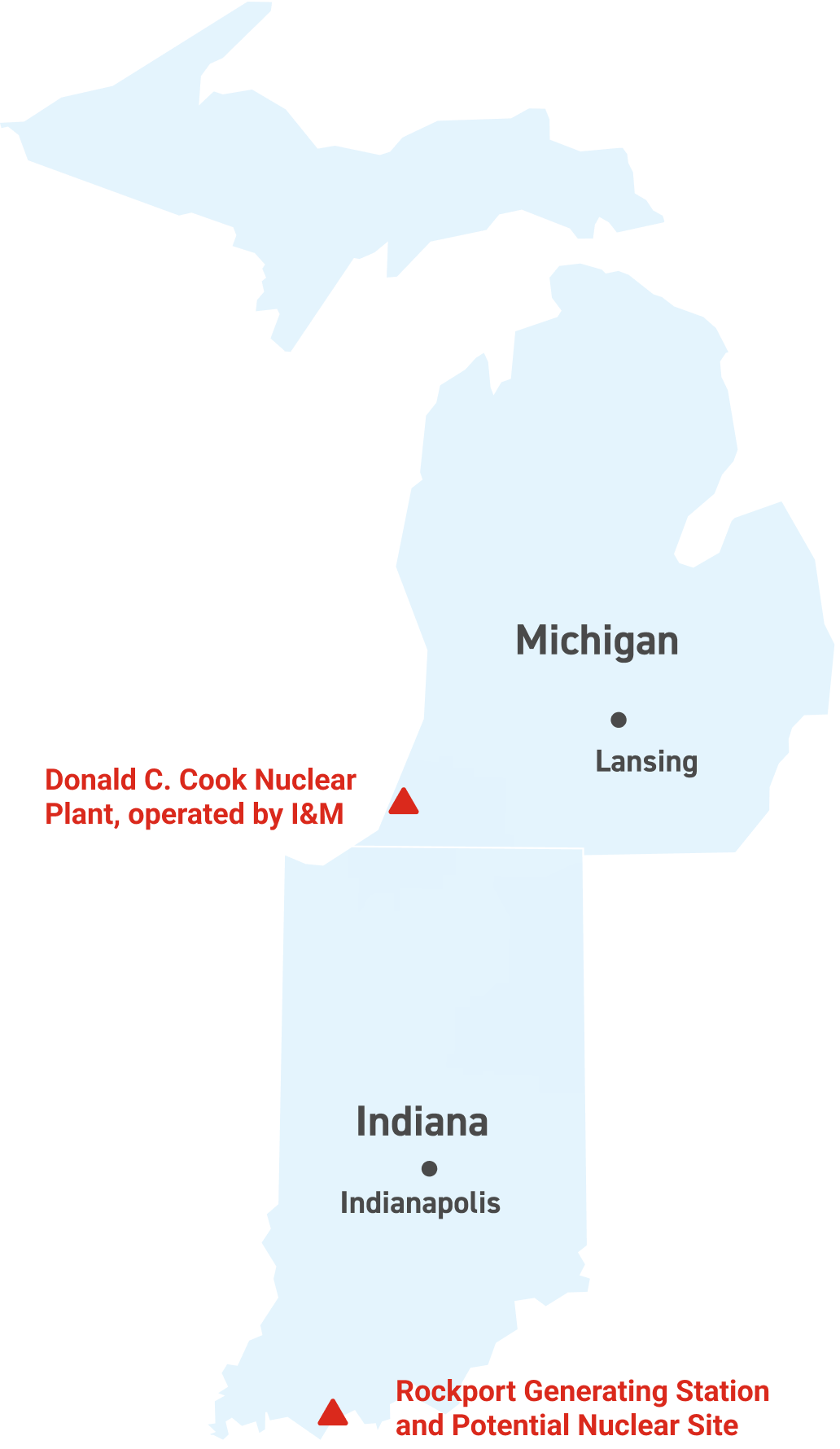
The Rockport site, owned by I&M, was chosen after a thorough evaluation of several other locations, based on the criteria set forth in the Electric Power Research Institute (EPRI) Siting Guide for assessing new nuclear energy generation sites.
It offers several key advantages to building advanced nuclear:
Existing Infrastructure: First, it is 4,500 acres and already has the necessary power delivery infrastructure in place making it more economical to develop.
Environmental Suitability: The site has been evaluated for its environmental impact and is deemed suitable for nuclear energy generation.
Skilled Workforce: The existing regional workforce is experienced and capable of operating and maintaining a major power plant, providing a pool of skilled labor for the project. By investing in the local workforce, the project will continue to provide a significant opportunity for skilled jobs for Spencer County and the surrounding communities.
Community Benefits: This project will enable I&M to continue supporting the local community and economy.
-
AEP and X-energy are evaluating the potential for a 960-megawatt small modular reactor plant near the former Breed Plant, a retired coal plant in Sullivan County that shut down in 1994, with Amazon supporting the project's development through a funding agreement.
The Sullivan County site offers several key advantages:
Existing Infrastructure: The potential project is being considered at the former Breed Plant site, which already has the needed infrastructure to connect to the regional grid.
Skilled Workforce: A regional workforce experienced with power plants benefits both the project development and the local community. By investing in the local workforce, the project would continue to provide a significant opportunity for skilled jobs for Sullivan County and the surrounding communities.
Community Benefits: A new nuclear project could bring new investment, economic activity and tax revenue to Sullivan County. The companies are committed to working closely with local leaders, residents, businesses and other stakeholders as the evaluation moves forward.
-
Nuclear power plants are among the safest means of generating electricity, and advanced nuclear technology designs are simpler than traditional nuclear facilities. Advanced nuclear designs that use water for cooling take advantage of natural forces like gravity, condensation or pressure differences to keep the reactor core safe. Non-water cooled advanced SMRs leverage passive physics, ensured both by the core physics and the materials used. For both types, as well as the Cook Nuclear plant, trained staff are on-site at all times to monitor safety systems. Advanced nuclear technology would operate under stringent regulatory oversight and include comprehensive operational safety and emergency response plans.
-
Indiana Michigan Power has taken multiple steps to protect customers and support affordability in our communities. In August 2026, we announced one of the nation’s largest base reductions plans, made possible thanks to load growth and increased revenue from large customers including data centers. This followed two I&M rate reductions in the first half of the year. I&M also signed the White House’s Ratepayer Protection Pledge, reaffirming our commitment to affordability for our customers. The Pledge promotes responsible growth and helps ensure customers benefit form new investments.
-
Providing our customers with reliable and low-carbon electricity at competitive rates is I&M’s priority. By pursuing strategic partnerships and technology-based incentives, I&M is taking steps to bring the next generation of reliable and clean nuclear energy to Indiana while minimizing cost impacts to I&M’s customers.
-
Rockport: I&M is evaluating a range of possible paths forward for this project, including potential partnerships, and we are not in a position to comment on any specific partnership discussions at this time. As additional details become available, I&M will share more information with the community.
Sullivan County: Yes. Amazon is supporting the development of the Sullivan County project through a funding agreement. If the project is determined to be feasible and gets built, Amazon would be the anchor customer, purchasing the plant's power under a long-term contract and covering the costs of the facility and its operations for the duration of the contract. That commitment is what could make the project commercially viable. This is a front-of-the-meter project: the power would go to the regional grid (PJM), not directly to a single customer's facility. The result would be 960 MW of new, carbon-free capacity that strengthens the grid for everyone in the region and supports economic growth in Indiana.
-
I&M’s reduced base rates and lower monthly charges over the last several months were made possible by load growth and increased revenue the company has experienced from large customers, including data centers. I&M continues to look for all opportunities that would make energy more affordable for Hoosiers, including evaluating potential partnerships with large-load customers. I&M has signed the White House’s Ratepayer Protection Pledge, and any potential nuclear generation project aligns with those commitments.
-
Development of advanced nuclear can provide significant economic benefits to communities and states. For example, construction of an SMR typically involves thousands of employees, creating a ripple effect that spurs additional indirect and direct employment opportunities. Operation of a small modular reactor can create hundreds of jobs, spur new economic activity, promote advanced training and educational opportunities and add millions of dollars in new annual local, state and federal tax revenue. The periodic refueling process for some SMR projects can also carry additional short-term economic benefits, including doubling the reactor's workforce with highly skilled contract workers for up to three months. In addition to the direct benefits associated with an SMR facility itself, the ability for I&M to provide customers with clean and reliable energy 24/7, 365 days a year will be an important tool to attract new businesses into I&M’s service area, which provides benefits to all I&M customers.
-
Nuclear energy is a proven clean energy technology. Nuclear power generation has been around since the 1950s and has seen massive growth globally since. It is a vital resource for successfully reducing carbon emissions while preserving reliable access to energy. According to the U.S. Energy Information Administration, in 2023, 18.6% of U.S. electricity came from nuclear power. Natural gas accounted for about 40%, followed by 21.4% from all renewable sources and 16.2% from coal. Nuclear power is the largest clean source of electricity generation in the U.S.
-
When it comes to managing spent fuel, advanced nuclear reactors are expected to operate in a manner consistent with conventional reactors. Currently, spent fuel is safely and securely stored at more than 70 reactor sites across the country. Spent fuel is placed in a storage pool of water to both cool and shield the material. These pools are constructed with thick reinforced concrete and steel liners and are often designed to hold all of the spent fuel produced over the planned operating life of the reactor. Once fuel is cooled in a pool, it is then stored in dry casks with air circulation inside concrete shielding. Utilities are reimbursed under their contract with the U.S. Department of Energy for most of the costs of long-term storage on site. Long-term storage of spent fuel on site must adhere to the NRC regulations, as existing large-scale commercial reactors do across the U.S.
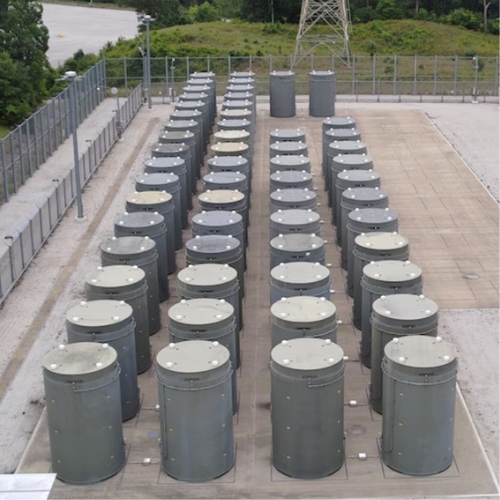
I&M is experienced with spent fuel storage management, as shown in the above pictured dry storage casks at the Donald C. Cook Nuclear Power Plant in Bridgman, Michigan. The dry storage casks shown contain the majority of the spent fuel for 2.3 gigawatts and nearly 50 years of operation.
Some advanced small modular reactors use coolants other than water, such as helium, and manage spent fuel differently. The Xe-100, the helium-cooled advanced reactor being evaluated for the Sullivan County site, uses TRISO fuel: tiny particles of uranium fuel, each sealed inside ceramic and carbon layers designed to trap and retain the radioactive byproducts created as the fuel is used. These particles are packed into graphite pebbles that act as their own permanent containment. As a result, spent fuel from the Xe-100 does not need to cool in a pool of water. It goes directly into specially designed canisters for dry storage, where it remains until it is placed in a final repository.
An Xe-100 plant is designed to safely store all of its spent fuel on site for its entire operational life of more than 60 years. Long-term storage of spent fuel on site must adhere to NRC regulations, as it does for existing commercial reactors across the U.S. Under the Nuclear Waste Policy Act, the U.S. Department of Energy holds the final legal responsibility to take title to the fuel and provide for permanent disposal in a geologic repository. This approach builds on I&M's decades of experience safely managing dry storage at the Cook Plant.
-
Advanced nuclear energy projects require ongoing, open engagement with the people and communities they could affect. At both the Rockport and Sullivan County sites, I&M is committed to working closely with local leaders, residents, businesses, community organizations, customers, regulators and other stakeholders. That means communicating openly, listening to questions and concerns, and providing updates at key milestones as potential projects move forward.